
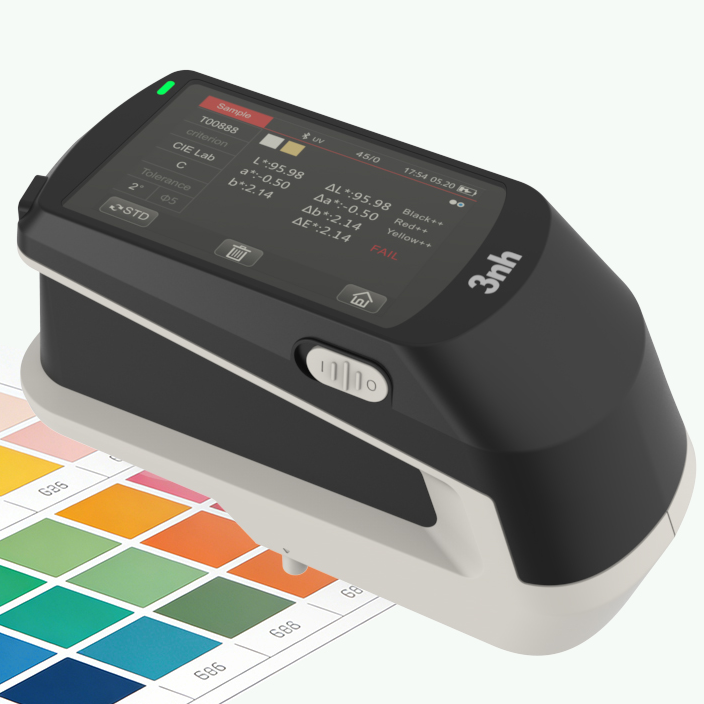
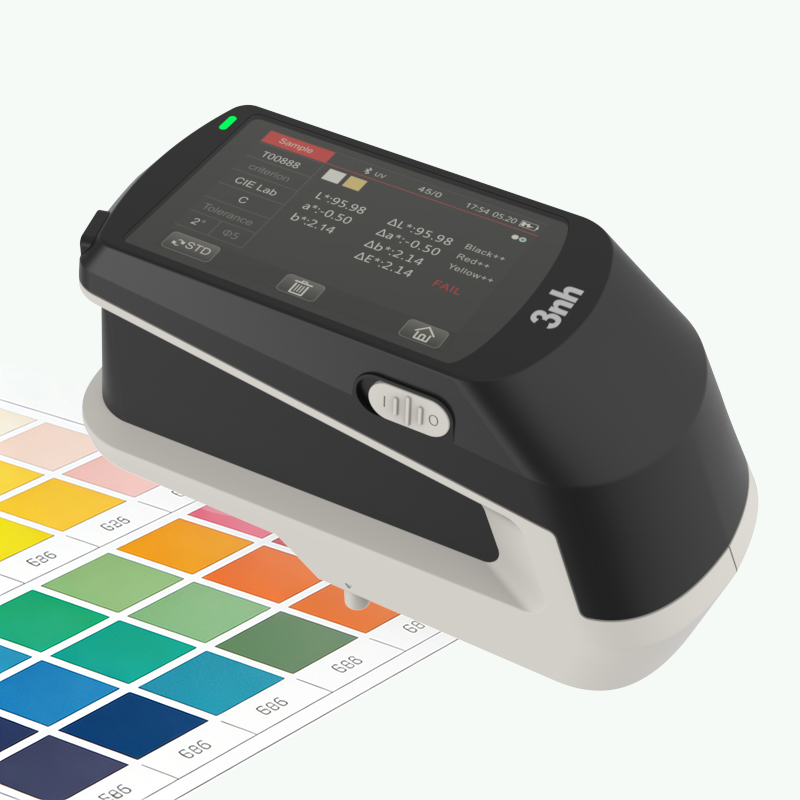
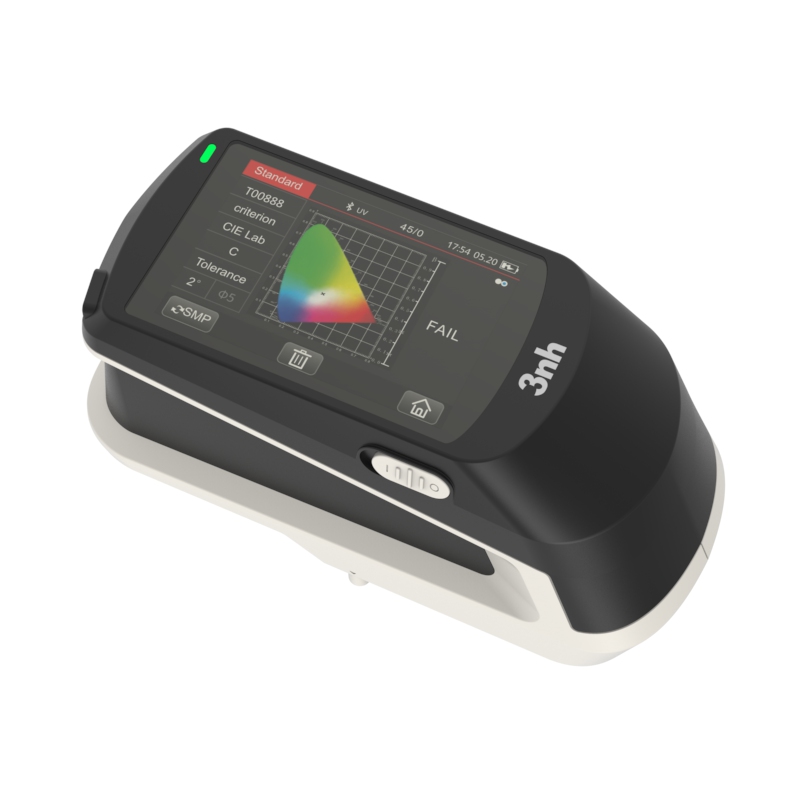
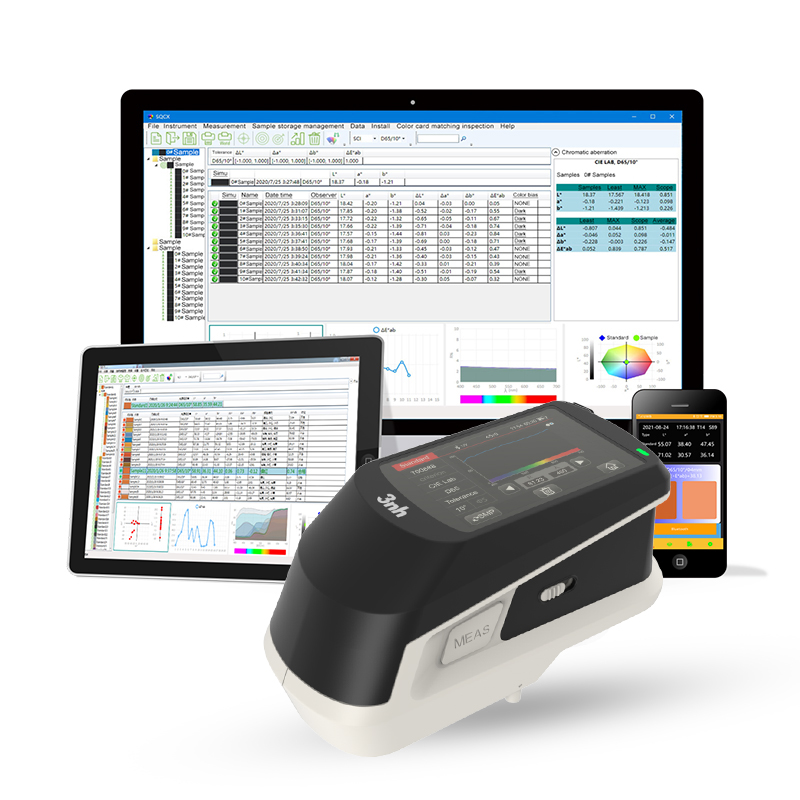
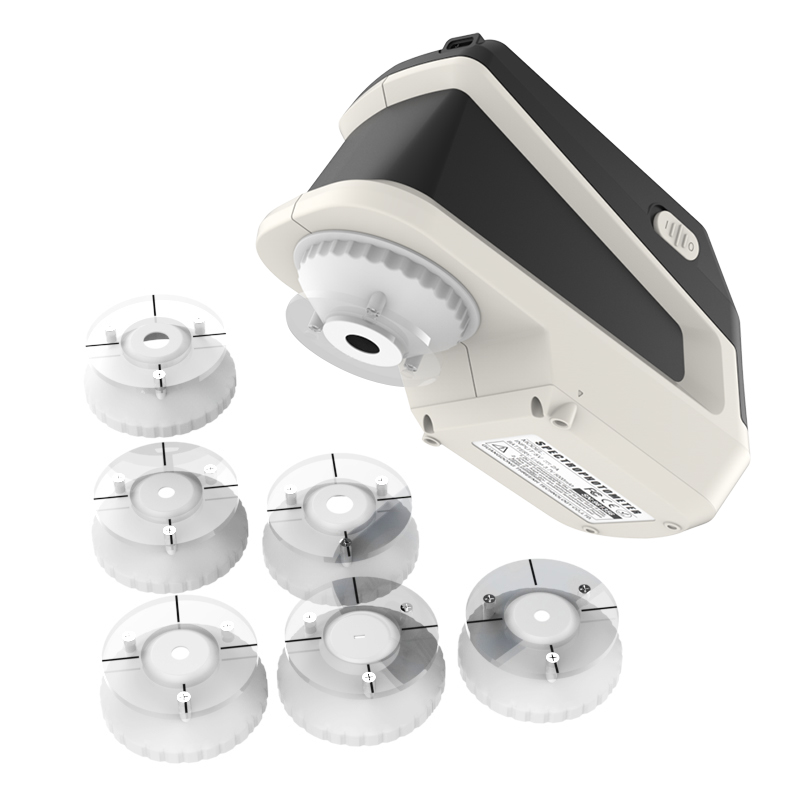
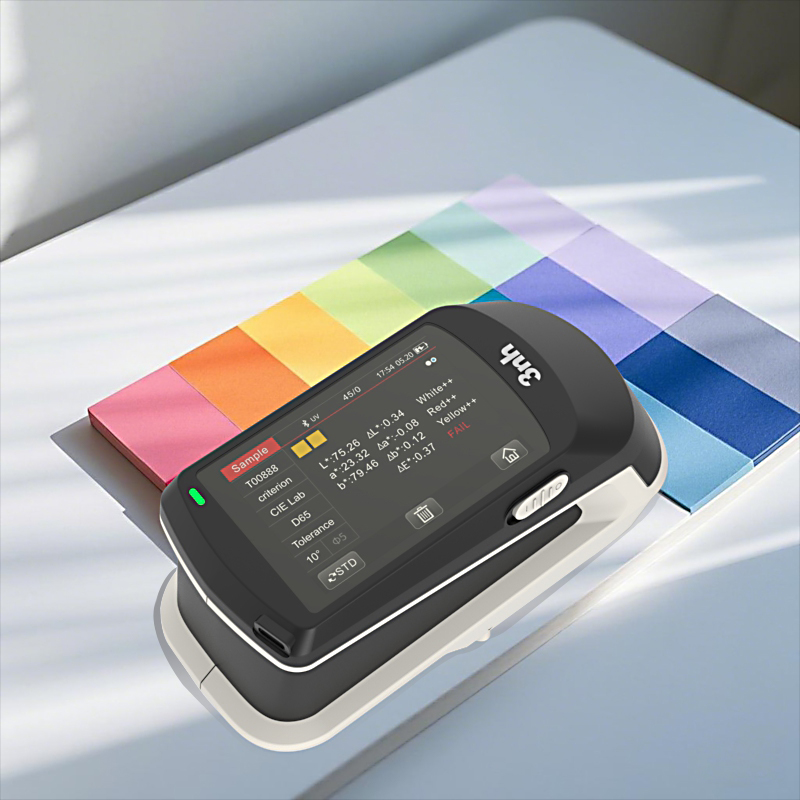
3nh TS-26C spectrophotometer is an enhanced laboratory-grade spectrophotometer independently developed by 3nh, specifically designed for high-precision color analysis and transmission scenarios. It adopts the internationally recognized 45/0 optical structure and incorporates a high-performance optical system, achieving rapid and accurate measurements within the 400–700nm spectral range. The product is equipped with seven measurement apertures to flexibly adapt to samples of different sizes and shapes, and has the capability to measure fluorescent samples. It also meets the requirements for measuring the luminance factor and chromaticity coordinates of traffic signs, markings, and reflective films. It includes GB 2893 and GB/T 18833 standard colors and supports manually customized polygonal rectangle tolerances, providing professional solutions for color management across various industries.
Optical geometry: The 45/0 illumination method (45° circular uniform illumination, 0° reception) is adopted, which complies with standards such as CIE No.15, GB/T 3978, and GB 2893 to ensure measurement standardization and data consistency.
Combined full-spectrum LED light source: It employs a combination of 400-700nm full-spectrum LED light source and UV light source, ensuring sufficient spectral distribution within the visible light range, avoiding spectral loss in specific wavelengths, preventing saturation under strong light, enhancing sensitivity under weak light, and allowing for easy measurement of fluorescent samples.
Silicon photodiode dual array (40 groups) sensor: Using larger area silicon photodiode array (40 groups in two rows) sensor effectively solves the problems of strong light saturation and weak light detection, ensuring the instrument's measurement speed and accuracy.

Repeatability accuracy:Within ΔE*ab 0.018,The repeatability accuracy of the instrument has reached a level that is difficult for similar products to match.
Inter-instrument Error: Within ΔE*ab 0.15,Ensure the measurement results from multiple devices are highly consistent.

It supports the measurement of luminance factor and chromaticity coordinates of traffic signs, markings, and reflective films, and is adapted to the strict requirements of the transportation industry for the consistency of road sign colors.
Built-in GB 2893 (safety colors) and GB/T 18833 (road traffic reflective film) standard colors, no need for additional import, and can manually customize polygonal rectangle tolerances to improve industry application efficiency.

Provides seven measuring apertures (12mm、11mm、10mm、6mm、5mm、3mm、1*3mm platform),It can be flexibly switched according to the sample size (such as small electronic components or large road signs) to adapt to diverse measurement scenarios.

Configure 10 color spaces: including CIE LAB、XYZ、Yxy、LCh、CIE LUV、s-RGB etc. It meets the color definition and analysis needs of different industries.
Supports 9 color difference formulas: including ΔEab、ΔEuv、ΔE94、ΔEcmc (2:1)、ΔE*00 etc, it can accurately quantify color differences and adapt to color difference judgment standards in different scenarios.
Rich colorimetric index: It supports measurements such as whiteness (WI), yellowness (YI), metamerism index (MI), blackness, and color density (CMYK), as well as staining fastness, color change fastness, force content, and opacity, covering the entire color evaluation process.
Supports observation of 41 light sources: including (D65、A、C、D50 etc,some are achieved through PC software)and 2°/10° view angle,It can simulate visual effects under different environments and meet the needs of color transmission across different scenarios.

Convenient operation: Equipped with a 3.5-inch TFT true-color capacitive touchscreen, it can intuitively display spectrum/data, colorimetric values, color difference values/comparison charts, and pass/fail judgment results, making it easy to operate.
USB + Bluetooth dual interface:Support USB +Bluetooth,It can connect to computers and printers, and is compatible with Android/iOS/Windows systems and WeChat mini programs, making data transmission and report generation more flexible.
High measurement efficiency:A single measurement takes only about 1 second, and it supports the storage of 1,000 standard samples and 30,000 test samples, meeting the long-term data traceability needs of a large number of samples.

Spectrocolorimeter | |
Model | TS-26C |
Illumination | 45/0(45 ring-shaped illumination, vertical viewing); Comply with CIE No.15,GB/T 3978,GB 2893,GB/T 18833,ISO7724-1,ASTM E1164,DIN5033 Teil7 |
Features | Enhanced spectrophotometer for precise color analysis and transmission in the laboratory; |
Light Source | Combined LED Light, UV Light |
Spectral separation device | Flat Grating |
Detector | Silicon photodiode array (dual array, 40 groups) |
Wavelength Range | 400~700nm |
Wavelength Pitch | 10nm |
Half Bandwidth | 10nm |
Reflectance resolution | 0.01% |
Reflectance Range | 0~200% |
Measuring Aperture | 7 aperture:12mm platform+11mm platform +10mm platform +6mm platform+5mm platform+3mm platform + 1*3mmplatform |
Color Space | CIE LAB,XYZ,Yxy,LCh,CIE LUV,s-RGB,HunterLab,βxy,DIN Lab99,Munsell(C/2) |
Color Difference Formula | ΔE*ab,ΔE*uv,ΔE*94,ΔE*cmc(2:1),ΔE*cmc(1:1),ΔE*00, DINΔE99,ΔE(Hunter) |
Other Colorimetric Index | WI(ASTM E313,CIE/ISO,AATCC,Hunter), |
Observer Angle | 2°/10° |
Illuminant | D65,A,C,D50,D55,D75,F1,F2,F3,F4,F5,F6,F7,F8,F9,F10,F11,F12,CWF,DLF,TL83,TL84,TPL5,U30,B,U35,NBF, |
Display Data | Spectrogram/Values, Chromaticity Values, Color Difference Values/Graph, Pass/Fail Result, Color Offset |
Measurement Time | About 1.5s |
Display resolution | 0.01 |
Repeatability | Spectral reflectance: MAV, Standard deviation within 0.07% (400 nm to 700 nm: within 0.2%) |
Inter-instrument Error | MAV,Within ΔE*ab 0.15 (Average for 12 BCRA Series II color tiles) |
Measurement mode | Single Measurement, Average Measurement(2-99) |
Size(L*W*H) | 169X73X87mm |
Weight | About 446g |
Battery power | Li-ion battery. 10000 measurements within 8 hours |
Illuminant Life Span | 5 years, more than 3 million times measurements |
Display | 3.5-inch TFT color LCD, Capacitive Touch Screen |
Interface | USB, Bluetooth 5.0 |
Data memory | Standard 1000 Pcs, Sample 30000 Pcs |
Language | Chinese Simplified, Chinese Traditional, English, Russian |
Software | Andriod,iOS,Windows,WeChat Mini Program |
Calibration | First Grade |
Working Environment | Temperature: 0~40℃; Humidity: 0~85% (No Condensation);altitude: less than 2000 m |
Storage Environment | Temperature: -20~50℃; Humidity: 0~85% (No Condensation) |
Standard Accessory | Power Adapter, USB Cable, Built-in li-ion battery, User Manual, software(download from the website)White and Black Calibration Board, Protective Cover, Measuring Apertures |
Optional Accessory | Micro Printer, Powder Test Box, Universal test components, Locating Plate |
Note | Technical specifications are for reference only; the actual product sold shall prevail. |
1. When I received NH310/NH300 colorimeter and perform measurement, why the measured data is abnormal?
After receiving NH310/NH300, you have to perform white and black calibration manually when first starting.
2. In which condition, manual white and black calibration and auto calibration are required for NH310?
a. It’s needed to perform manual calibration for NH310 when first starting.
b. In the subsequent starting, NH310 will perform auto calibration at startup. No need to perform manual calibration.
c. Suggestion: it’s best to perform manual calibration once a week or when NH310 measured data is not accurate.
3. In which condition, manual white and black calibration for NH300 is required?
a. It’s needed to perform manual calibration for NH300 when first starting.
b. In the subsequent starting, no need to perform manual calibration.
c. Suggestion: it’s best to perform manual calibration once a week or when NH300 measured data is not accurate.
4. How to replace NH310 measuring aperture?
There are three measuring apertures for NH310: Φ8mm (standard accessory), Φ4mm (standard accessory), extended Φ8mm (optional accessory)
a. Turning on
b. Removing measuring aperture, install the needed measuring aperture.
c. Select “Settings-Aperture Setting” in main menu to select corresponding measuring aperture.
d. After selecting aperture, the instrument will display “White and Black Calibration” interface. White and black calibration must be performed.
e. Replace completed.
5. CQCS3 (Color Quality Control System) Installation
a. Before installation, please Copy CQCS3 folder to your computer and don’t remove any files in CQCS3 folder.
b. Double-click the setup.exe to install CQCS3 software.
c. Then double-click Install.bat under the CQCS3\USB_Driver file to install the driver.
d. Detailed installation information please read the "Installing Software" under CQCS3 User manual.doc.
6. How to check communication port?
a. Connect colorimeter to the PC with USB cable.
b. Turn on the colorimeter to enter main menu. Select “Comm” and press “Enter” key to start communication.
c. Right click on “My Computer” on the desktop. Click “Manage” -> “Device Manager” -> “Ports”, you can see similar display as “SCI USB2Serial (COM6)”.
d. Click “Settings->Communication Parameters” in CQCS3 software interface. Select the corresponding port in “Serial Port”.
7. After completing CQCS3 installation, how to solve the problem if it display “! USB Device” or “! SCI USB2Serial (COM6)” when checking the communication port?
a. Right click “! USB Device” or “! SCI USB2Serial (COM6)”, “Update Driver” -> “Install from a list or specific location (Advanced)” -> “Next” ->“Include this location in the search” -> “Browse”, specify USB driver file path “CQCS3\USB_Driver”, click “Next”. Then it will install successfully.
b.Detailed installation information please refers to “2.2 Installing USB Driver” in Color Quality Management System User Manual.doc.
8. Notes for First Using CQCS3 Software
a. Users must specify Standard File Name, Sample File Name and Sample Database File Name when first use.
b.Standard File is use to store standard measurement data. Sample File is used to store sample measurement data. Sample Database File is used to store the measured data exported from sample records.
9. How to solve the problem when “Connection Timeout” occurred?
a. When the colorimeter is disconnected to the PC, “Connection Timeout” will occur. At the moment, you have to check whether the USB cable is well connected the colorimeter and the PC. Then you can re-plug the USB to try out.
b. After ensuring the colorimeter is connected to the PC with USB cable, turn on the colorimeter and enter the main menu. Select “Comm” and press “Enter” key to start communication.
c. Turn off CQCS3 software, and reopen it.
10. How to solve the problem when the interface display "USB Disconnect"
a. Check whether the USB cable is connected. If not, please connect it. Check whether the connection is effective. You can re-plug the USB cable to test.
b. If the USB cable is connected well but the interface still displays "USB Disconnect", please re-start the colorimeter and enter "Menu" -"Comm"to start the communication.
c. Change the USB cable or change the USB port in you PC.
11. How to solve the problem when the colorimeter cannot be turned on in the condition of battery-powered?
a. If this phenomenon occurred, it means the battery power is not enough. You need to charge the battery.
b. When charge the battery, please insert the battery to the instrument, and plug in the adapter to charge the battery. After 5 minutes, the instrument can be turned on.
c. If the instrument still cannot be turned on after charging 5 minutes, you can pull out the adapter and re-plug in to check it. Or repeat this operation.
d. If the instrument still cannot be turned on after charging 5 minutes, you can turn off the colorimeter and turn on it again to check it. Or repeat this operation.
e. If you have tried all the methods above but the colorimeter still cannot be turned on, please change the battery.
