
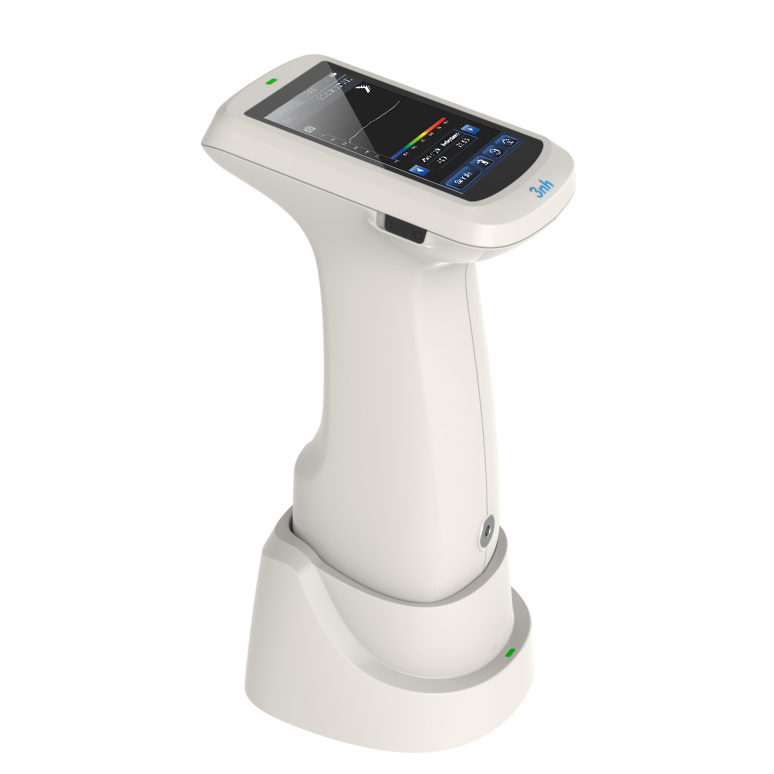
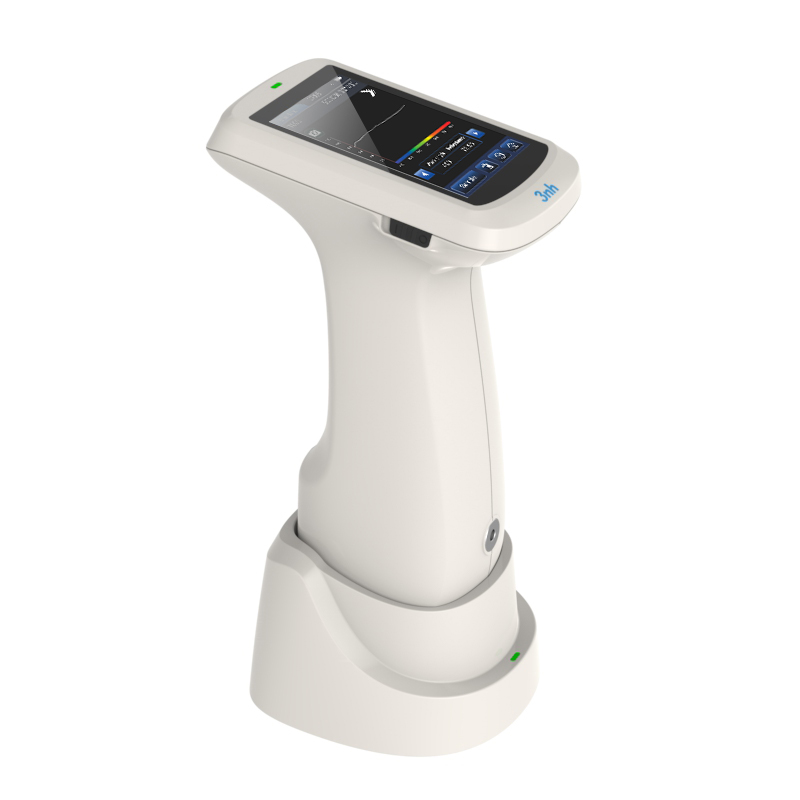
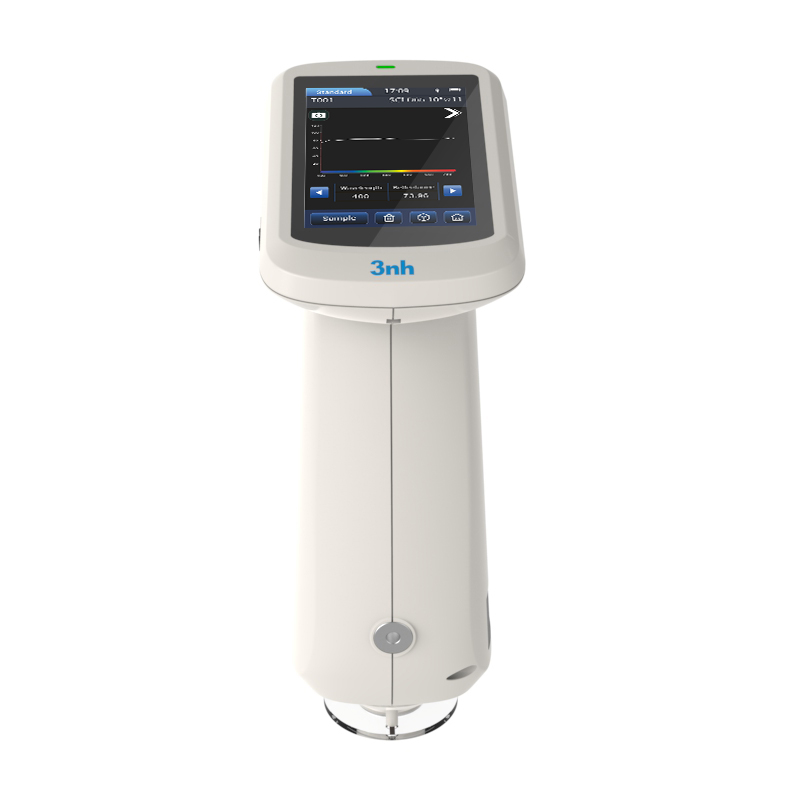
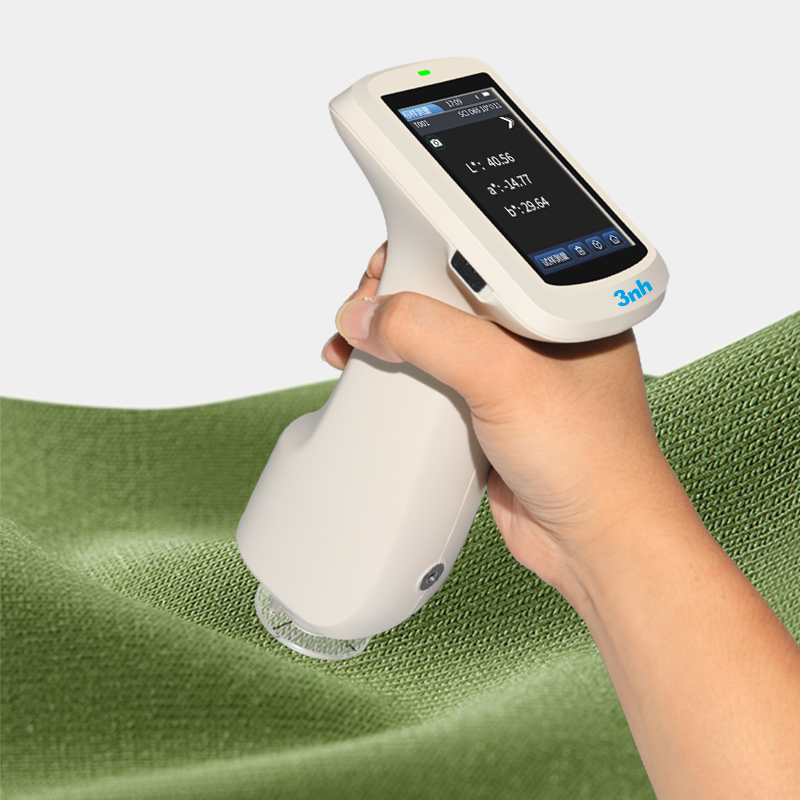
3NH KS-100 Spectrophotometer
Designed for routine color measurement, featuring stability, reliability, and portability with easy operation. Equipped with a dual-row 18-element silicon photodiode array and nano-integrated spectral device, it delivers a repeatability of ΔEab ≤ 0.028 and inter-instrument agreement of ΔEab ≤ 0.35, meeting basic color control needs in industries such as plastics, electronics, printing, and ceramics. With 4 measurement apertures adaptable to flat or curved samples, it supports multi-system connectivity and camera framing for precise targeting—enabling quick mastery even for beginners without complex training.
1.High-Precision Performance, Reliable Data
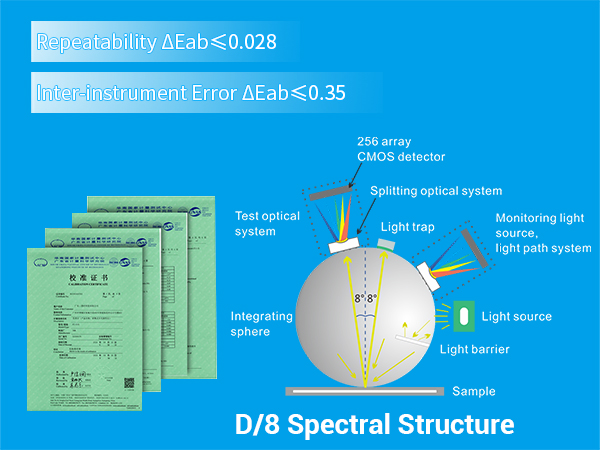
Repeatability: ΔEab ≤ 0.028, Inter-instrument Agreement: ΔEab ≤ 0.35, Ensures color consistency in batch production.
Dual-beam optical system monitors light source energy fluctuations in real time, reducing measurement interference to enhance stability and repeatability.
2.Internationally Recognized D/8 SCI/SCE Technology
Adheres to D/8 illumination and viewing geometry with SCI/SCE technology. Suitable for industries such as coatings, textiles, and plastics. Complies with CIE, ISO, ASTM, and other international standards, meeting industry color management specifications.
3.Authorized Metrological Certification, Credible Results
Each unit is factory-calibrated and certified by an authoritative body. Measurement data is traceable to national metrology institutes, ensuring the authority of test results.
1.Core Optical Components for Precise Spectral Capture
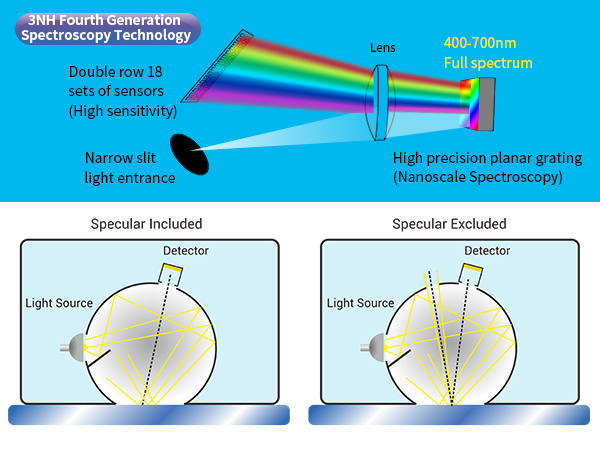
Silicon Photodiode Array (Dual-row, 18 groups): :Large-area design ensures no saturation under strong light and high sensitivity in low light. Spectral response covers 400-700nm with a 10nm interval. Reflectance measurement range: 0-200%, accurately capturing visible light information.
Nano-integrated Spectral Device: Nanoscale spectroscopic capability accurately separates light of different wavelengths, ensuring the precision of band data.
Full-band Balanced LED Light Source: Covers the full 400-700nm spectrum, avoiding spectral gaps and ensuring measurement accuracy.
2.Advanced Hardware Architecture for Both Efficiency and Precision
Optical resolution of less than 10nm within the visible light range.
Supports simultaneous measurement of SCI (Specular Component Included) and SCE (Specular Component Excluded) spectra.
Balances speed, accuracy, and stability.
1.Ergonomic Design and Easy Measurement Assistance
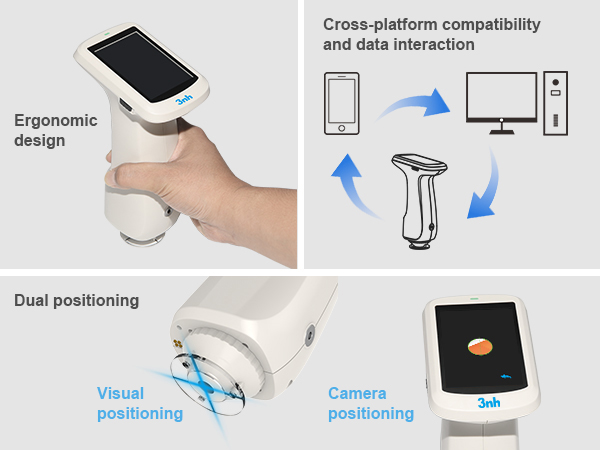
Ergonomic exterior design conforms to natural grip habits. Equipped with a large, clear touchscreen featuring intuitive operation logic. Enables quick mastery for beginners without complex training, improving on-site efficiency.
2.Stabilizer Plate + Camera Targeting for Reduced Measurement Errors
Dual positioning system combining a stabilizer plate and a camera. Real-time viewing confirms if the measured area is exactly the target center. Precisely locks onto the measurement spot, minimizing errors caused by manual operation.
3.Multi-Platform Compatibility and Data Interaction
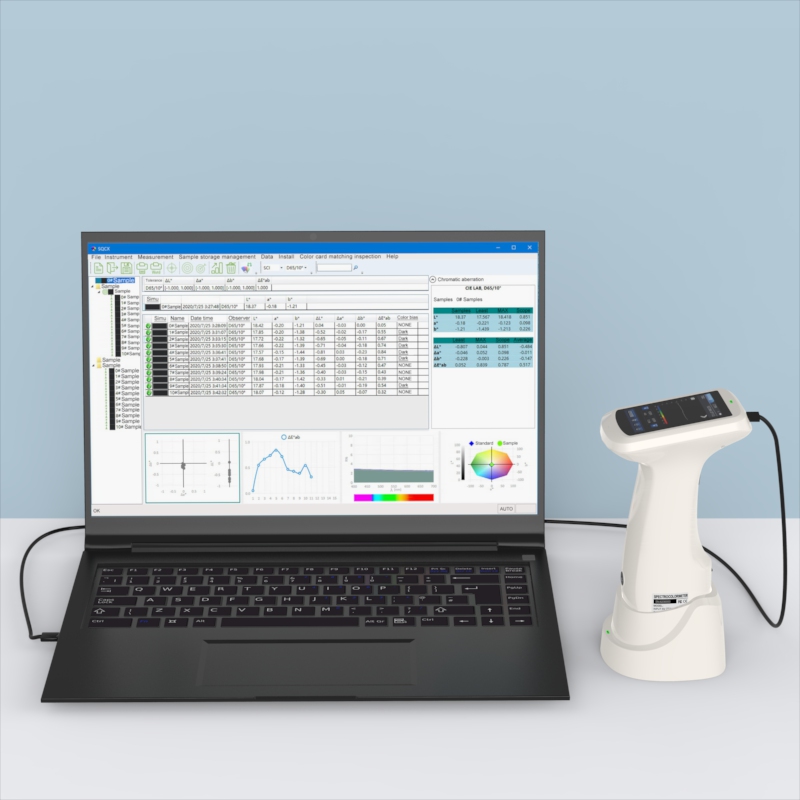
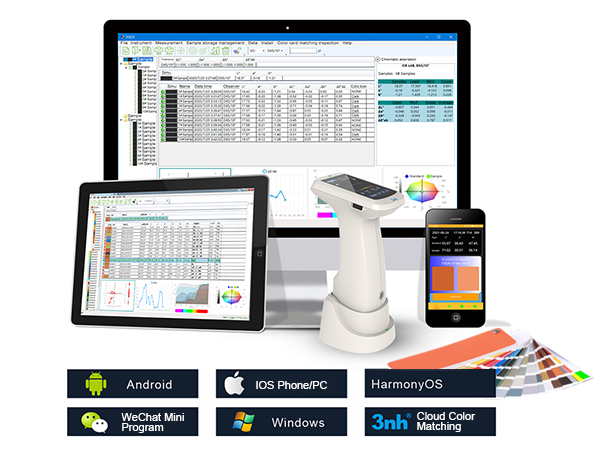
Supports Android, iOS, Windows, HarmonyOS, and other systems. Compatible with mobile apps, WeChat mini-programs, and PC software. Enables cross-device data synchronization, facilitating flexible on-site operation and efficient data management.
1.Multi-Aperture Design for Different Samples
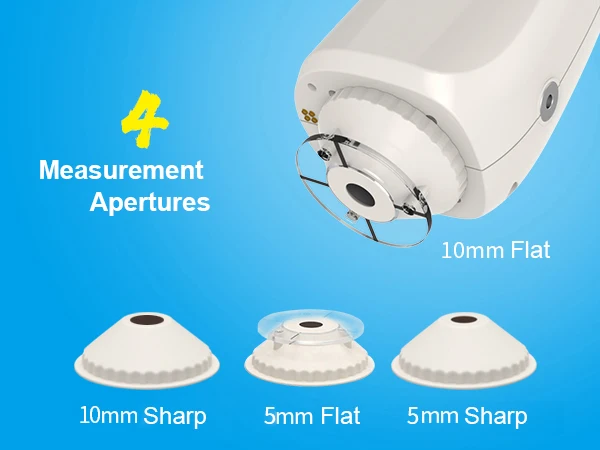
Equipped with 4 measurement apertures (5mm/10mm platform + pointed tip). Suitable for samples of various forms, including flat, curved, and concave-convex surfaces.
2.Cross-Industry Adaptability for Diverse Needs
Switchable measurement modes to flexibly meet testing requirements in industries such as plastics, electronics, paints and inks, textile dyeing and printing, printing, and ceramics.
1.Cloud Storage for Portable Data Access
Supports mass color data storage via the mobile app and WeChat mini-program, enabling the creation of a personal cloud database. Eliminates the need for physical color cards, allowing instant data sharing with partners anytime, anywhere for convenient collaboration.
2.Multi-Platform Color Management Software for Industrial-Level Needs
The accompanying quality management software is compatible with Android, iOS, Windows, WeChat mini-programs, HarmonyOS, and the Color Matching Cloud platform. Generates test reports, compares color difference data, and enables customized color management workflows, meeting industrial-level quality control requirements.
| Model | KS-100 Spectrophotometer |
| Illumination/Viewing Geometry | D/8 (Diffuse illumination, 8° viewing), SCI/SCE (Specular Component Included/Excluded). Compliant with CIE No.15, GB/T 3978, GB 2893, GB/T 18833, ISO7724-1, ASTM E1164, DIN5033 Teil7. |
| Features | Utilizes a dual-path silicon photodiode array. Ideal for color difference quality control in industries such as plastics, electronics, paints and inks, textile dyeing and printing, printing, and ceramics. |
| Light Source | Combined full-spectrum LED light source. |
| Integrating Sphere Size | Φ40mm |
| Spectral Device | Nano-integrated spectral device |
| Sensor | Silicon photodiode array (dual-row, 18 groups) |
| Wavelength Range | 400-700nm |
| Wavelength Interval | 10nm |
| Measurement Aperture | 4 Apertures: 5mm platform + 5mm pointed tip + 10mm platform + 10mm pointed tip. |
| Specular Mode | Simultaneous measurement |
| Color Space | CIE LAB |
| Color Difference Formula | ΔE*ab |
| Other Color Indices | / |
| Observer Angle | 2°/10° |
| Calibrated Illuminants | D65 |
| Display Data | Spectral graph/data, sample color values, color difference values/graph, pass/fail results, color simulation, color bias |
| Measurement Time | Approx. 1 second |
| Repeatability |
Chromaticity Value: Within ΔE*ab 0.028 (Standard deviation) for MAV/SCI (after warm-up and calibration, average of 30 readings of white board at 5s intervals). Spectral Reflectance: Within 0.1% standard deviation for MAV/SCI (within 0.2% for 400-700nm). |
| Inter-Instrument Error | Within ΔE*ab 0.35 for MAV/SCI (average of 12 BCRA Series II color tiles). |
| Displayed Accuracy | 0.01 |
| Reflectance Range | 0-200% |
| Reflectance Resolution | 0.01% |
| Measurement Mode | Single measurement, average measurement (2-99 times). |
| Targeting | Stabilizer plate positioning + Camera framing. |
| White Calibration | Contact-type white calibration. |
| Dimensions | 120*75*207mm |
| Weight | 367g(without calibration base) |
| Battery | Lithium-ion battery, 3.7V, 3200mAh, supports 8000 measurements within 8 hours. |
| Light Source Life | Over 1.2 million measurements for 10 years. |
| Display | TFT true color 3.5-inch capacitive touch screen. |
| Interface | USB,Bluetooth |
| Data Storage | 200 standards, 10,000 samples (SCI/SCE data included in one record). Mass storage via APP/PC. |
| Software Support | Android, iOS, Windows, WeChat Mini-Program, HarmonyOS. |
| Languages | Simplified Chinese, English, Traditional Chinese |
| Operating Environment | Temperature: 0~40℃, Humidity: 0~85% RH (non-condensing), Altitude: below 2000m. |
| Storage Environment | Temperature: -20~50℃, Humidity: 0~85% RH (non-condensing). |
| Accuracy Guarantee | Guaranteed metrological certification. |
| Standard Accessories | Power adapter, data cable, user manual, quality management software (download from official website), white calibration box, protective cover, wrist strap, measurement apertures. |
| Optional Accessories | Micro-printer, powder test box. |
| Note | Specifications are subject to change without prior notice. |
1. When I received NH310/NH300 colorimeter and perform measurement, why the measured data is abnormal?
After receiving NH310/NH300, you have to perform white and black calibration manually when first starting.
2. In which condition, manual white and black calibration and auto calibration are required for NH310?
a. It’s needed to perform manual calibration for NH310 when first starting.
b. In the subsequent starting, NH310 will perform auto calibration at startup. No need to perform manual calibration.
c. Suggestion: it’s best to perform manual calibration once a week or when NH310 measured data is not accurate.
3. In which condition, manual white and black calibration for NH300 is required?
a. It’s needed to perform manual calibration for NH300 when first starting.
b. In the subsequent starting, no need to perform manual calibration.
c. Suggestion: it’s best to perform manual calibration once a week or when NH300 measured data is not accurate.
4. How to replace NH310 measuring aperture?
There are three measuring apertures for NH310: Φ8mm (standard accessory), Φ4mm (standard accessory), extended Φ8mm (optional accessory)
a. Turning on
b. Removing measuring aperture, install the needed measuring aperture.
c. Select “Settings-Aperture Setting” in main menu to select corresponding measuring aperture.
d. After selecting aperture, the instrument will display “White and Black Calibration” interface. White and black calibration must be performed.
e. Replace completed.
5. CQCS3 (Color Quality Control System) Installation
a. Before installation, please Copy CQCS3 folder to your computer and don’t remove any files in CQCS3 folder.
b. Double-click the setup.exe to install CQCS3 software.
c. Then double-click Install.bat under the CQCS3\USB_Driver file to install the driver.
d. Detailed installation information please read the "Installing Software" under CQCS3 User manual.doc.
6. How to check communication port?
a. Connect colorimeter to the PC with USB cable.
b. Turn on the colorimeter to enter main menu. Select “Comm” and press “Enter” key to start communication.
c. Right click on “My Computer” on the desktop. Click “Manage” -> “Device Manager” -> “Ports”, you can see similar display as “SCI USB2Serial (COM6)”.
d. Click “Settings->Communication Parameters” in CQCS3 software interface. Select the corresponding port in “Serial Port”.
7. After completing CQCS3 installation, how to solve the problem if it display “! USB Device” or “! SCI USB2Serial (COM6)” when checking the communication port?
a. Right click “! USB Device” or “! SCI USB2Serial (COM6)”, “Update Driver” -> “Install from a list or specific location (Advanced)” -> “Next” ->“Include this location in the search” -> “Browse”, specify USB driver file path “CQCS3\USB_Driver”, click “Next”. Then it will install successfully.
b.Detailed installation information please refers to “2.2 Installing USB Driver” in Color Quality Management System User Manual.doc.
8. Notes for First Using CQCS3 Software
a. Users must specify Standard File Name, Sample File Name and Sample Database File Name when first use.
b.Standard File is use to store standard measurement data. Sample File is used to store sample measurement data. Sample Database File is used to store the measured data exported from sample records.
9. How to solve the problem when “Connection Timeout” occurred?
a. When the colorimeter is disconnected to the PC, “Connection Timeout” will occur. At the moment, you have to check whether the USB cable is well connected the colorimeter and the PC. Then you can re-plug the USB to try out.
b. After ensuring the colorimeter is connected to the PC with USB cable, turn on the colorimeter and enter the main menu. Select “Comm” and press “Enter” key to start communication.
c. Turn off CQCS3 software, and reopen it.
10. How to solve the problem when the interface display "USB Disconnect"
a. Check whether the USB cable is connected. If not, please connect it. Check whether the connection is effective. You can re-plug the USB cable to test.
b. If the USB cable is connected well but the interface still displays "USB Disconnect", please re-start the colorimeter and enter "Menu" -"Comm"to start the communication.
c. Change the USB cable or change the USB port in you PC.
11. How to solve the problem when the colorimeter cannot be turned on in the condition of battery-powered?
a. If this phenomenon occurred, it means the battery power is not enough. You need to charge the battery.
b. When charge the battery, please insert the battery to the instrument, and plug in the adapter to charge the battery. After 5 minutes, the instrument can be turned on.
c. If the instrument still cannot be turned on after charging 5 minutes, you can pull out the adapter and re-plug in to check it. Or repeat this operation.
d. If the instrument still cannot be turned on after charging 5 minutes, you can turn off the colorimeter and turn on it again to check it. Or repeat this operation.
e. If you have tried all the methods above but the colorimeter still cannot be turned on, please change the battery.
