
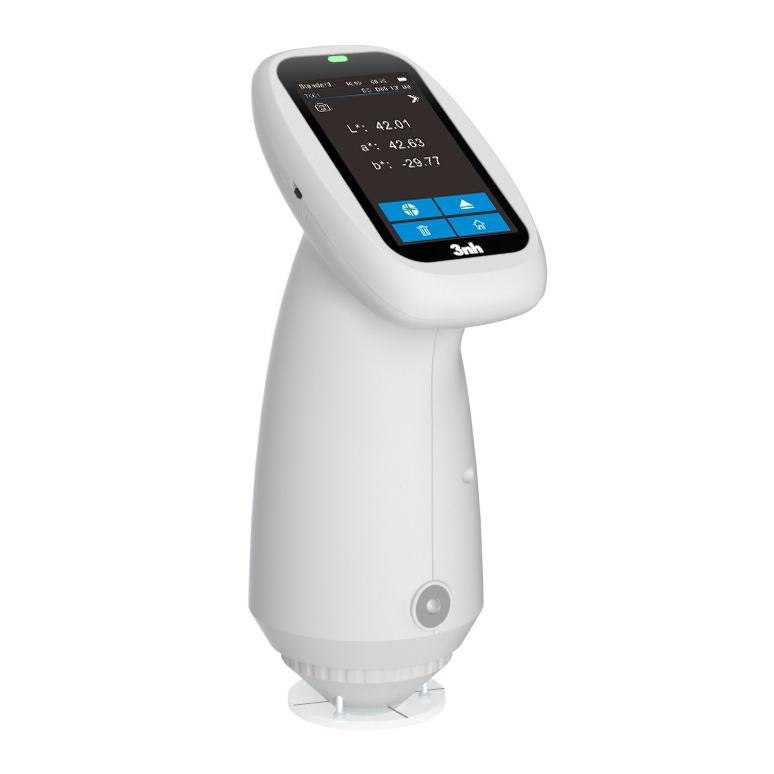
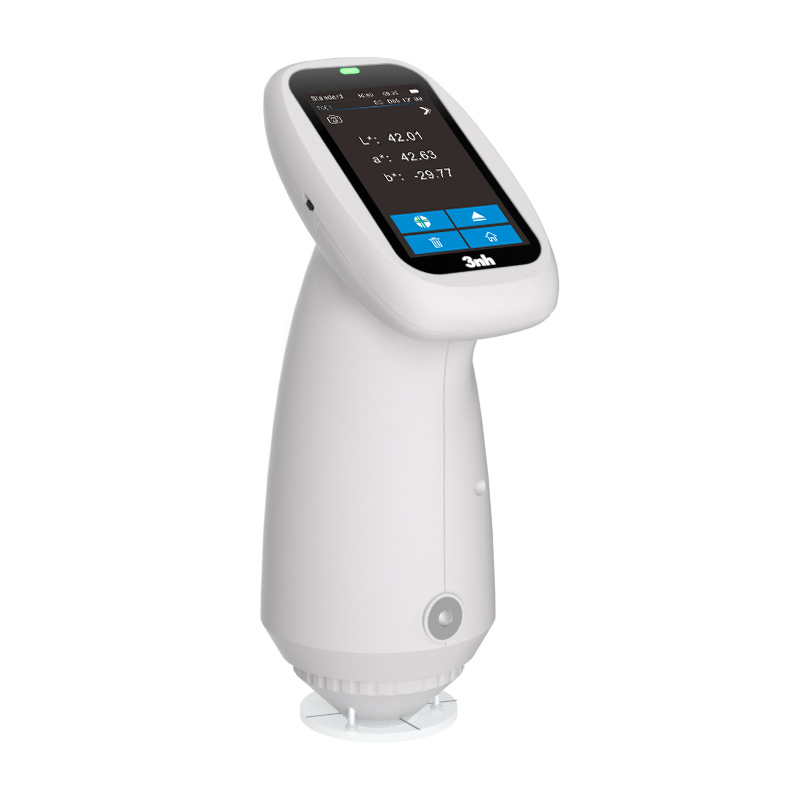
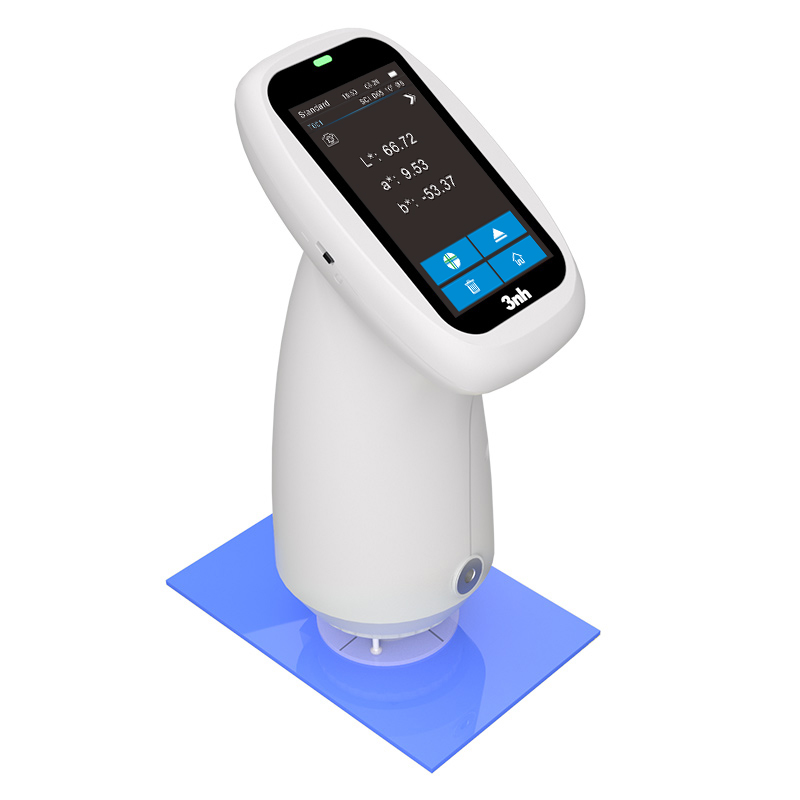
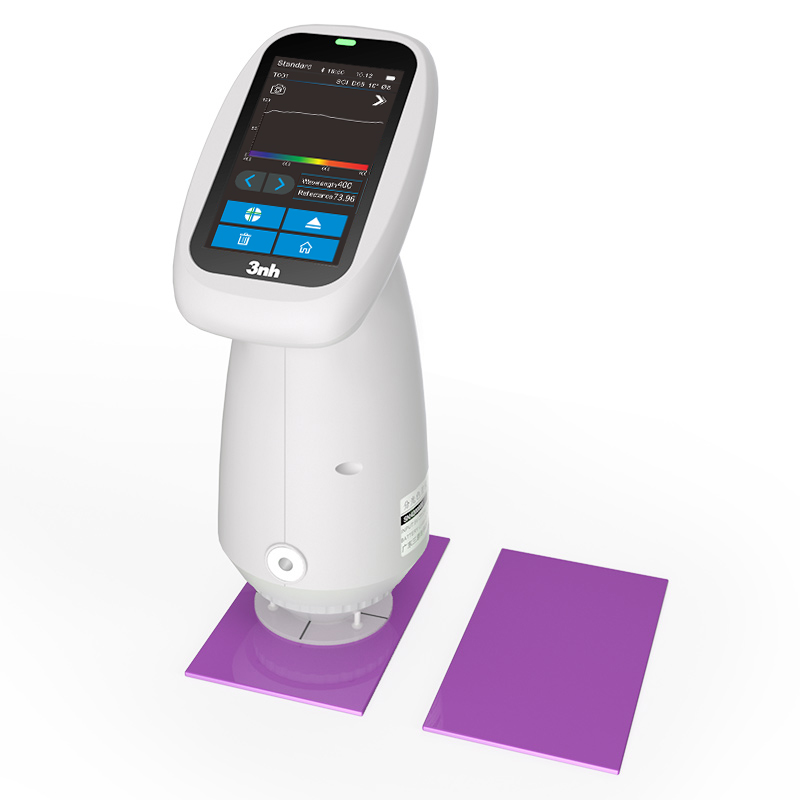
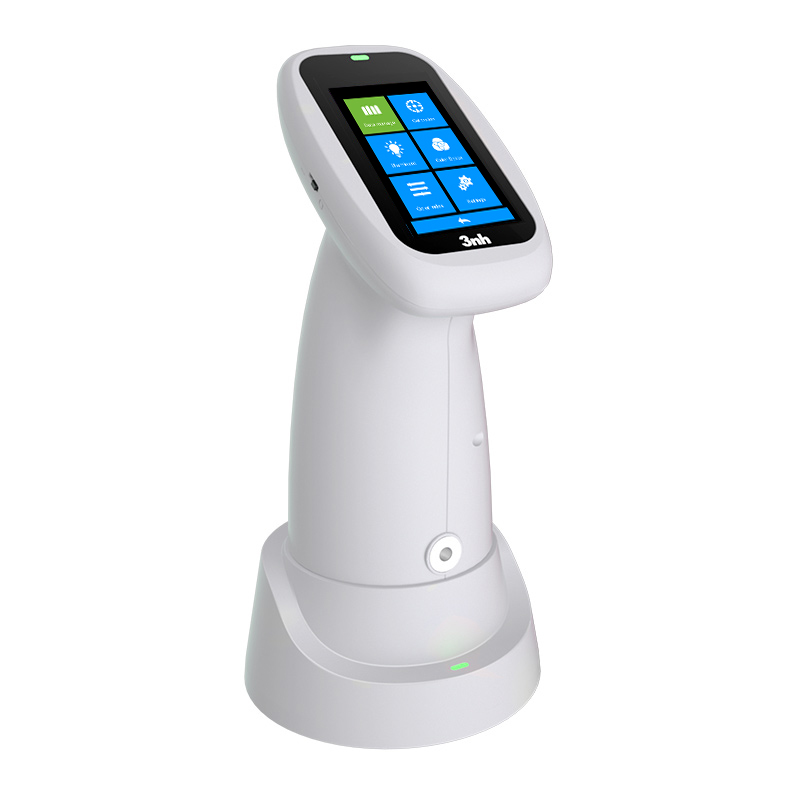
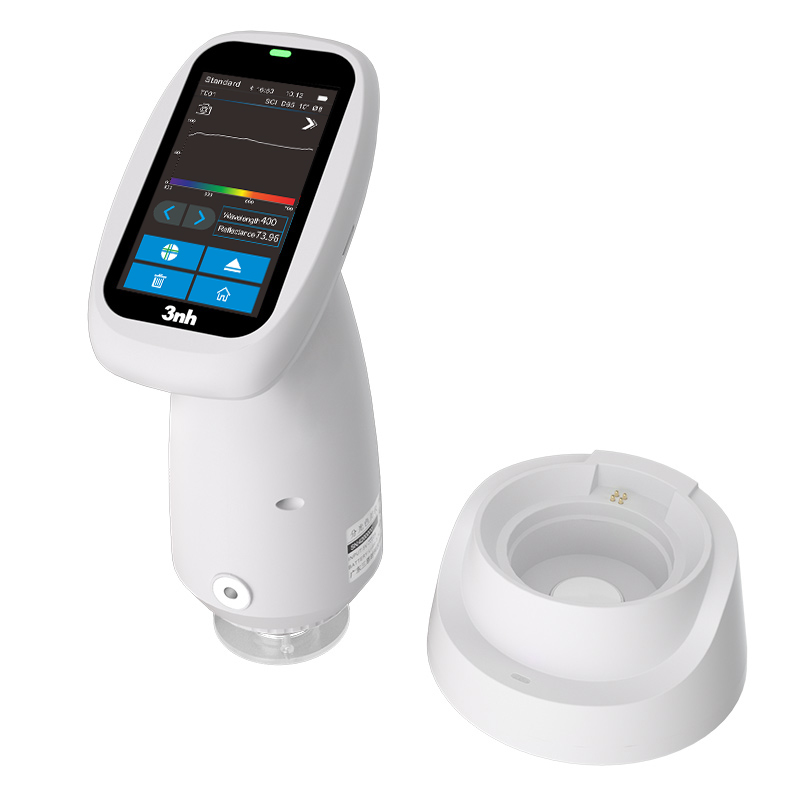
The PS220 Spectrophotometer is elaborately crafted with a silicon photodiode array (dual-row 16 groups) sensor. It is not only an accurate colorimeter but also a powerful spectrophotometer. The instrument features excellent repeatability and inter-instrument agreement, ensuring consistent, stable, accurate and reliable measurement data. Its design inherits the comfortable and rounded appearance of the series, delivering a smooth operating experience.
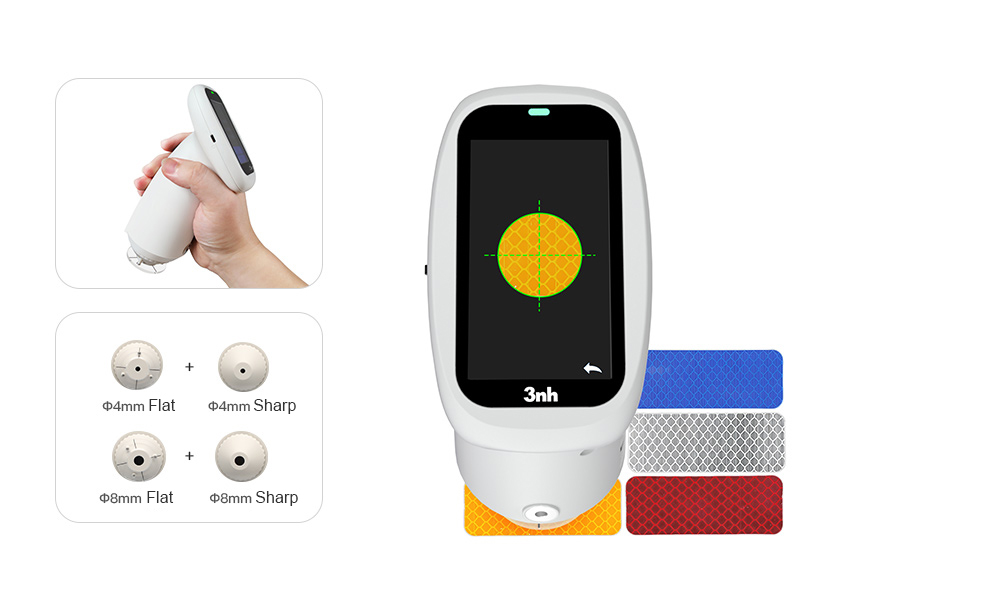
Equipped with four measurement apertures: Φ8mm (platform + pointed nozzle) and Φ4mm (platform + pointed nozzle), the PS220 boasts multiple color spaces and chromaticity analysis capabilities, meeting the stringent quality control needs of various industries.
Product Features
Core Performance
Illumination and Observation Geometry: Adopts the internationally universal D/8 illumination and observation condition, supporting SCI (Specular Component Included) measurement mode. It complies with multiple domestic and international standards such as CIE No.15 and GB/T 3978, ensuring the authority and universality of measurement results.
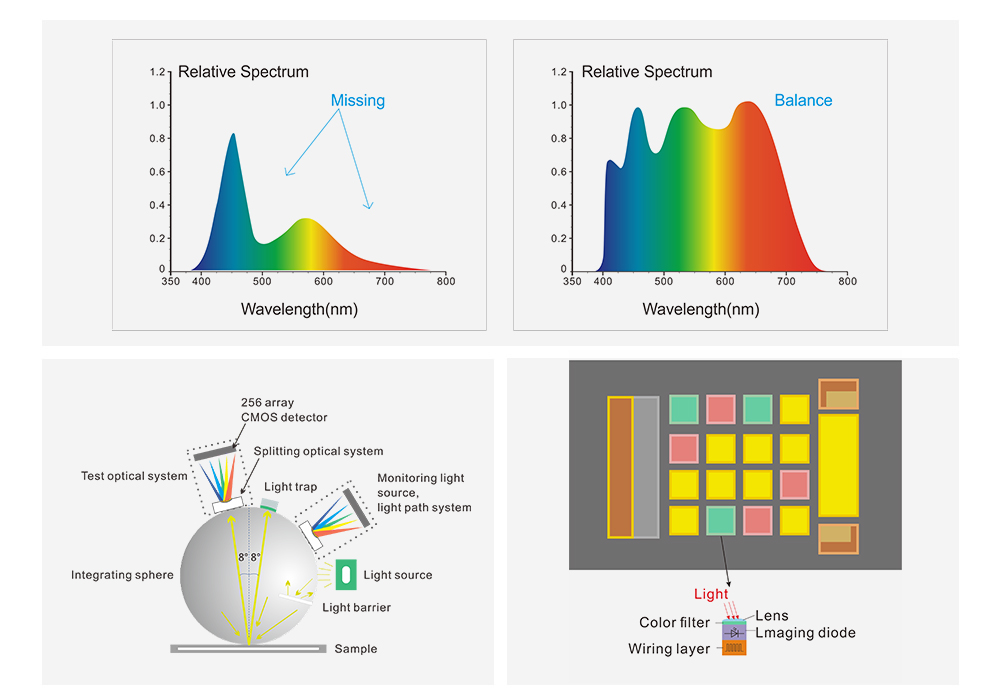
Dual Optical Path Design: Equipped with a silicon photodiode array (dual-row 16 groups) sensor, combined with a Φ40mm integrating sphere, improving data processing efficiency and accuracy.
Full-Wavelength LED Light Source: 400-700nm full-spectrum collection with uniform spectral distribution within the visible light range, avoiding spectral loss of white LEDs in specific bands and ensuring measurement precision.
Repeatability: The standard deviation of chromaticity value ΔE*ab ≤ 0.02, ensuring strong consistency of measurement results.
Inter-Instrument Agreement: ΔE*ab ≤ 0.3, with small differences in measurement results between different instruments, suitable for collaborative control of multiple instruments
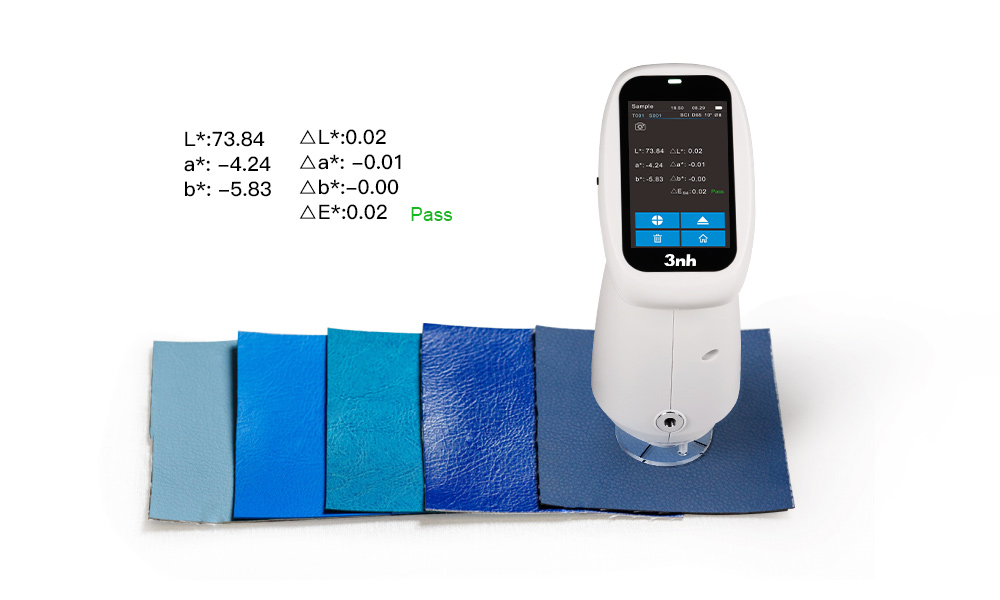
Human-Computer Interaction: Equipped with a 2.8-inch TFT true-color capacitive touch screen, supporting one-key measurement on the device. The interface intuitively displays spectral graphs, chromaticity values, color differences, pass/fail judgment results and color simulation tendency, simplifying the operation process.
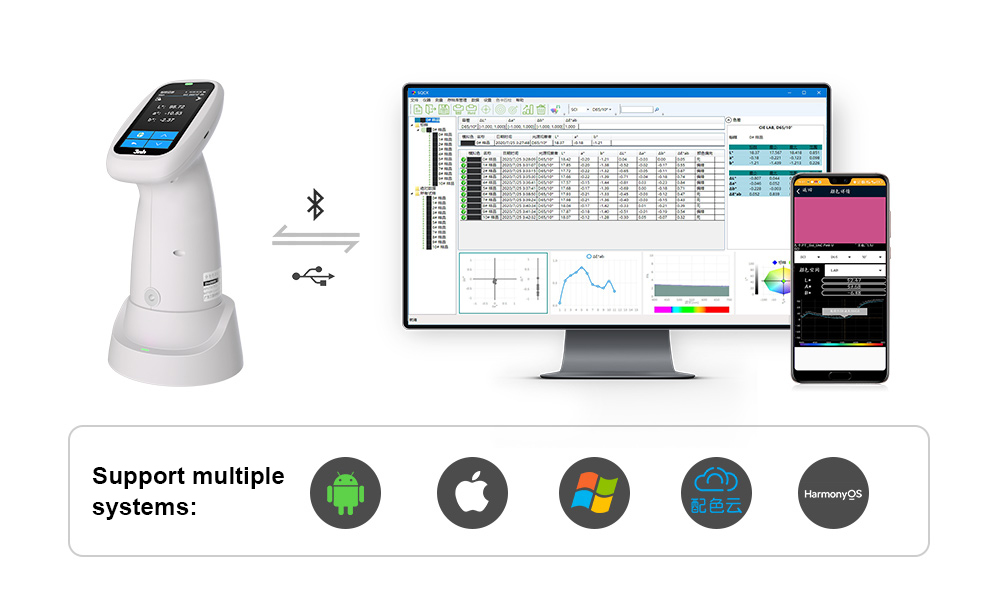
Multi-Terminal Collaboration: Supports USB and Bluetooth 5.0 connection to computers, mobile phones (compatible with multiple systems) and WeChat Mini Programs, realizing data synchronization, report generation and cloud storage (200 standard samples, 10,000 test samples). Use the App or Mini Program to establish your private color database in the cloud, eliminating the need to carry heavy color cards and enabling convenient sharing with partners anytime, anywhere.
Function Highlights
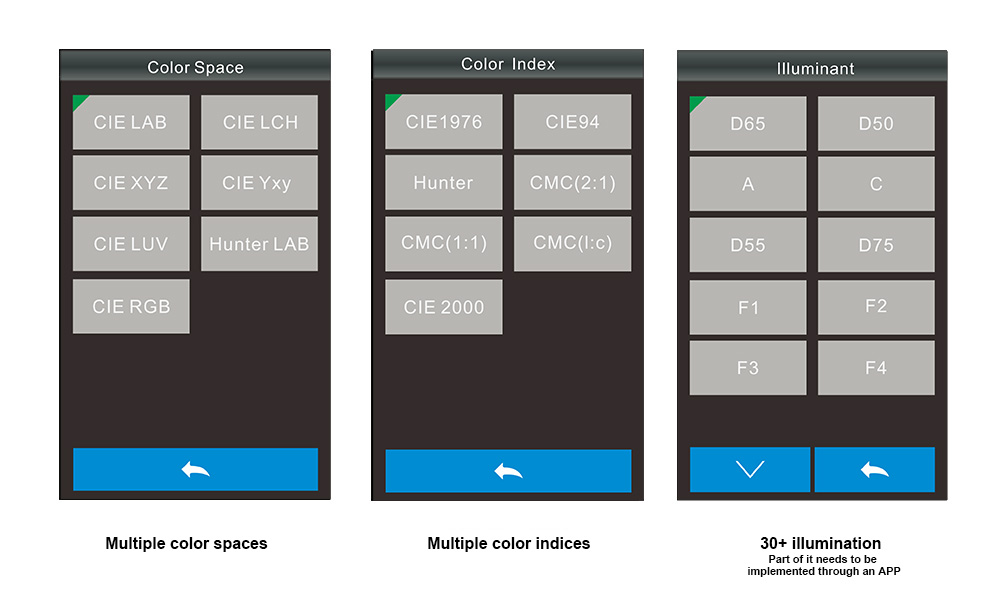
Color Spaces and Formulas: Supports multiple color spaces such as CIE LAB, XYZ, and HunterLab, as well as mainstream color difference formulas including ΔEab, ΔEcmc, and ΔE*00. It can measure multiple chromaticity indicators such as spectral reflectance, whiteness (WI), yellowness (YI), metamerism index Mt, and staining/discoloration fastness. Some functions (such as Munsell color number and CMYK) are realized through the mobile App.
Observation Light Sources: Built-in more than 30 light sources (such as D65, A, C, D50, etc., some extended through the App), meeting the color evaluation needs under different lighting conditions.
Ergonomic Design and Easy Measurement Device: Features an elegant and smooth appearance with a comfortable grip, ergonomic structure design that fits the palm, suitable for continuous detection work. Equipped with an automatic measurement easy-to-measure device, it is portable, fast, and easy to use.
Flexible Measurement Apertures: Provides four measurement apertures: Φ8mm/Φ10mm (platform + pointed nozzle) and Φ4mm/Φ5mm (platform + pointed nozzle), adapting to samples of different sizes (such as conventional industrial parts, small electronic components, curved ink coatings, etc.). Equipped with a stabilizer for positioning and calibration to ensure accurate measurement positions.
Built-in HD Camera for Clear Observation of Measured Area: The built-in camera for framing and positioning can accurately judge whether the measured part of the object is the target center through real-time framing, improving measurement efficiency and accuracy.
Technical Specifications
Product Model | PS220 Spectrophotometer |
Illumination Method | D/8 (Diffuse Illumination, 8° Direction Reception), SCI (Specular Component Included), complying with standards CIE No.15, GB/T 3978, GB 2893, GB/T 18833, ISO7724-1, ASTM E1164, DIN5033 Teil7 |
Features | Used for color difference quality control in industries such as plastic electronics, paint and ink, textile, garment and printing and dyeing, printing, and ceramics. |
Illumination Light Source | Combined Full-Spectrum LED Light Source |
Integrating Sphere Size | Φ40mm |
Spectroscopic Method | Nano-Integrated Spectral Device |
Sensor | Silicon Photodiode Array (Dual-Row 16 Groups) |
Measurement Wavelength Range | 400-700nm |
Measurement Aperture |
MAV: Φ8mm/Φ10mm (Platform + Pointed Nozzle Measurement Aperture); |
Light Inclusion Method | SCI |
Color Space | CIE LAB,XYZ,Yxy,LCh,CIE LUV,s-RGB,HunterLab,βxy,DIN Lab99 |
Color Difference Formula | ΔE*ab,ΔE*uv,ΔE*94,ΔE*cmc(2:1),ΔE*cmc(1:1),ΔE*00, DINΔE99,ΔE(Hunter) |
Other Chromaticity Indicators | Spectral Reflectance, WI (ASTM E313, CIE/ISO, AATCC, Hunter), YI (ASTM D1925, ASTM 313), Metamerism Index Mt, Staining Fastness, Discoloration Fastness, Strength, Coverage, 555 Tone Classification, Munsell (C/2) (Realized by Mobile App), CMYK |
Observer Angle | 2°/10° |
Observation Light Source | D65,A,C,D50,D55,D75, F1,F2(CWF),F3,F4,F5,F6, F7(DLF),F8,F9,F10(TPL5), F11(TL84),F12(TL83/U30), U35,NBF,ID50,ID65, LED-1,LED-2,LED-3,LED-4,LED-5 ,LED-6,LED-7,LED-8,LED-9, LED-10 (Some realized by Mobile App) |
Display | Spectral Graph/Data, Sample Chromaticity Value, Color Difference Value/Graph, Pass/Fail Result, Color Simulation, Color Tendency |
Measurement Time | Approx. 1s |
Repeatability | Chromaticity Value: MAV/SCI, Standard Deviation ΔE*ab ≤ 0.02 (After preheating and calibration, average value of 30 measurements on white board at 5s intervals)Spectral Reflectance: MAV/SCI, Standard Deviation ≤ 0.08% (400~700nm: ≤ 0.18%) |
Inter-Instrument Agreement | MAV/SCI, ΔE*ab ≤ 0.3 (Average value of measurements on 12 BCRA Series II color plates) |
Display Precision | 0.01 |
Reflectance Measurement Range | 0-200% |
Reflectance Resolution | 0.01% |
Measurement Method | Single Measurement, Average Measurement (2~99 times) |
Positioning Method | Stabilizer Positioning + Camera Framing Positioning |
White Board Calibration Method | Contact White Board Calibration |
Dimensions | Length × Width × Height = 94 × 68 × 188mm (Excluding Calibration Base) |
Weight | 410g (Excluding Calibration Base) |
Battery Capacity | Lithium Battery, 3.7V, 3200mAh, 8000 Measurements Within 8 Hours |
Illumination Light Source Lifespan | More Than 1.2 Million Measurements in 10 Years |
Display Screen | TFT True Color 2.8inch, Capacitive Touch Screen |
Interface | USB,Bluetooth®5.0 |
Data Storage | 200 Standard Samples, 10,000 Test Samples (One Piece of Data Can Include SCI/SCE Simultaneously), Mass Storage on App/PC |
Software Support | Android, IOS, Windows, WeChat Mini Program, HarmonyOS |
Languages | Simplified Chinese, English, Traditional Chinese |
Operating Temperature Range | 0~40°, 0~85%RH (No Condensation), Altitude: Below 2000m |
Storage Temperature Range | -20~50°, 0~85%RH (No Condensation) |
Standard Accessories | Power Adapter, Data Cable, Instruction Manual, Quality Management Software (Download from Official Website), White Calibration Box, Protective Cover, Wrist Strap, Measurement Aperture |
Optional Accessories | Mini Printer, Powder Test Box |
Note | Technical parameters are for reference only, subject to the actual product sold. |
Application Fields
The PS220 Spectrophotometer is widely used in color difference detection, color matching management and color quality control in industries such as plastic electronics, paint and ink, textile, garment and printing and dyeing, printing, and ceramics.
1. When I received NH310/NH300 colorimeter and perform measurement, why the measured data is abnormal?
After receiving NH310/NH300, you have to perform white and black calibration manually when first starting.
2. In which condition, manual white and black calibration and auto calibration are required for NH310?
a. It’s needed to perform manual calibration for NH310 when first starting.
b. In the subsequent starting, NH310 will perform auto calibration at startup. No need to perform manual calibration.
c. Suggestion: it’s best to perform manual calibration once a week or when NH310 measured data is not accurate.
3. In which condition, manual white and black calibration for NH300 is required?
a. It’s needed to perform manual calibration for NH300 when first starting.
b. In the subsequent starting, no need to perform manual calibration.
c. Suggestion: it’s best to perform manual calibration once a week or when NH300 measured data is not accurate.
4. How to replace NH310 measuring aperture?
There are three measuring apertures for NH310: Φ8mm (standard accessory), Φ4mm (standard accessory), extended Φ8mm (optional accessory)
a. Turning on
b. Removing measuring aperture, install the needed measuring aperture.
c. Select “Settings-Aperture Setting” in main menu to select corresponding measuring aperture.
d. After selecting aperture, the instrument will display “White and Black Calibration” interface. White and black calibration must be performed.
e. Replace completed.
5. CQCS3 (Color Quality Control System) Installation
a. Before installation, please Copy CQCS3 folder to your computer and don’t remove any files in CQCS3 folder.
b. Double-click the setup.exe to install CQCS3 software.
c. Then double-click Install.bat under the CQCS3\USB_Driver file to install the driver.
d. Detailed installation information please read the "Installing Software" under CQCS3 User manual.doc.
6. How to check communication port?
a. Connect colorimeter to the PC with USB cable.
b. Turn on the colorimeter to enter main menu. Select “Comm” and press “Enter” key to start communication.
c. Right click on “My Computer” on the desktop. Click “Manage” -> “Device Manager” -> “Ports”, you can see similar display as “SCI USB2Serial (COM6)”.
d. Click “Settings->Communication Parameters” in CQCS3 software interface. Select the corresponding port in “Serial Port”.
7. After completing CQCS3 installation, how to solve the problem if it display “! USB Device” or “! SCI USB2Serial (COM6)” when checking the communication port?
a. Right click “! USB Device” or “! SCI USB2Serial (COM6)”, “Update Driver” -> “Install from a list or specific location (Advanced)” -> “Next” ->“Include this location in the search” -> “Browse”, specify USB driver file path “CQCS3\USB_Driver”, click “Next”. Then it will install successfully.
b.Detailed installation information please refers to “2.2 Installing USB Driver” in Color Quality Management System User Manual.doc.
8. Notes for First Using CQCS3 Software
a. Users must specify Standard File Name, Sample File Name and Sample Database File Name when first use.
b.Standard File is use to store standard measurement data. Sample File is used to store sample measurement data. Sample Database File is used to store the measured data exported from sample records.
9. How to solve the problem when “Connection Timeout” occurred?
a. When the colorimeter is disconnected to the PC, “Connection Timeout” will occur. At the moment, you have to check whether the USB cable is well connected the colorimeter and the PC. Then you can re-plug the USB to try out.
b. After ensuring the colorimeter is connected to the PC with USB cable, turn on the colorimeter and enter the main menu. Select “Comm” and press “Enter” key to start communication.
c. Turn off CQCS3 software, and reopen it.
10. How to solve the problem when the interface display "USB Disconnect"
a. Check whether the USB cable is connected. If not, please connect it. Check whether the connection is effective. You can re-plug the USB cable to test.
b. If the USB cable is connected well but the interface still displays "USB Disconnect", please re-start the colorimeter and enter "Menu" -"Comm"to start the communication.
c. Change the USB cable or change the USB port in you PC.
11. How to solve the problem when the colorimeter cannot be turned on in the condition of battery-powered?
a. If this phenomenon occurred, it means the battery power is not enough. You need to charge the battery.
b. When charge the battery, please insert the battery to the instrument, and plug in the adapter to charge the battery. After 5 minutes, the instrument can be turned on.
c. If the instrument still cannot be turned on after charging 5 minutes, you can pull out the adapter and re-plug in to check it. Or repeat this operation.
d. If the instrument still cannot be turned on after charging 5 minutes, you can turn off the colorimeter and turn on it again to check it. Or repeat this operation.
e. If you have tried all the methods above but the colorimeter still cannot be turned on, please change the battery.
